
ai porn generator
lovescape.com
What Happens When Adult Content Becomes Customizable?
For most of its history, adult entertainment followed a one-directional model. Studios produced content, distributors packaged it, and viewers chose from whatever menu of options happened to exist. That relationship is shifting. Advances in artificial intelligence now let individuals shape adult content around their own preferences rather than sorting through material made by someone else for a general audience. The shift raises practical questions about how the technology works, who benefits, and what it means for an industry built on fairly rigid production pipelines.
Customization in this context does not simply mean picking a category from a dropdown menu. It means generating new visual or narrative material based on specific inputs, adjusting details like appearance, setting, or scenario on demand, and doing so without waiting for a studio to produce it first. This changes the basic economics and expectations of the space. Understanding what drives that change requires looking at the technology itself, the platforms building on it, and the broader consequences that follow.
The Technology Behind On-Demand Generation
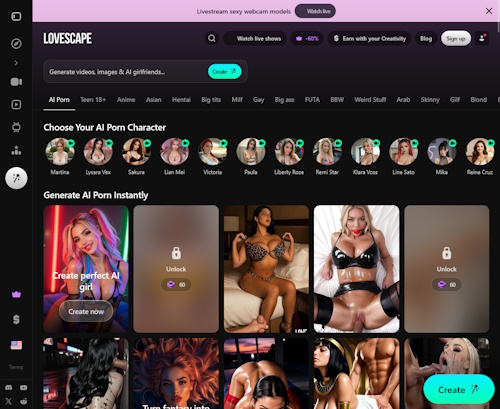
The core capability behind customizable adult content comes from generative AI models, particularly diffusion models and generative adversarial networks (GANs), which learn patterns from large sets of images and then produce new visual material based on text or image prompts. Lovescape is one of the platforms built around this technology, offering an ai porn generator that lets a user describe attributes or scenarios in plain language and receive generated imagery matching those specifications. The system is not retrieving an existing photo or video; it is constructing pixels from learned patterns, which is why outputs can vary infinitely even from similar prompts.
This process depends heavily on training data quality and model architecture. Earlier generative tools produced noticeably artificial results, with distorted hands, inconsistent lighting, or unnatural textures. Newer models have narrowed that gap substantially, producing results that are far more convincing and, in many cases, difficult to distinguish from conventionally produced content at a glance. The improvement has happened quickly, driven by the same broader advances in image synthesis that have affected art generation, video production, and other creative fields.
Why Personalization Changes User Expectations
Once people experience content shaped to their own specifications, the standard menu-based model starts to feel limited by comparison. A viewer accustomed to adjusting details in real time has different expectations than one accustomed to scrolling through pre-made catalogs. This mirrors patterns seen in other media industries, where recommendation algorithms and customizable formats gradually retrained audiences to expect tailored experiences rather than static offerings.
The appeal isn't only about specificity of preference. Speed matters too. Traditional production cycles, even for shorter clips, involve casting, filming, and editing that take days or weeks. Generative tools compress that timeline to seconds or minutes, which changes how people think about accessing this kind of content altogether. Instant availability, paired with granular control over details, creates a different relationship between viewer and material than the passive consumption model that dominated for decades.
Consent, Likeness, and the Legal Gray Zones
Customizable generation introduces consent questions that didn't exist in the same form before. When a system can generate a face or body based on a prompt, there is a real risk that someone could attempt to recreate a real person's likeness without permission. This has already prompted legislative responses in multiple jurisdictions, with laws targeting non-consensual synthetic imagery, sometimes referred to broadly as deepfakes, gaining traction as lawmakers try to address harms that existing statutes weren't designed to cover.
Platforms operating responsibly in this space have had to build in safeguards, such as filters that block prompts referencing real, identifiable individuals and restrictions preventing the generation of content depicting minors. These measures are not universal across the industry, and enforcement varies considerably depending on jurisdiction and platform policy. The absence of a single global standard means the same generative capability can be governed very differently depending on where a user or company is based.
Age verification adds another layer of complexity as generated content is created rather than filmed; some of the usual production-side safeguards, such as verifying performer age during filming, don't apply in the same way. This has pushed the burden of compliance toward output-side content moderation and platform-level restrictions instead, requiring companies to build detection systems that can flag problematic prompts before generation even happens.
Shifts in Industry Structure and Business Models
The economics of adult content are moving away from flat subscription fees toward usage-based pricing, where users pay per generation, per credit, or per customization request rather than a single monthly rate for access to a fixed library. This mirrors pricing shifts seen in other AI-driven sectors, where computing costs scale with output volume, making it harder for companies to offer unlimited access at a flat price without eventually adjusting margins. For consumers, it means spending patterns look less like a Netflix-style subscription and more like a metered utility.
Performers and talent agencies are navigating a parallel disruption on the labor side. Some studios have begun licensing performers' likenesses to generative platforms under specific contractual terms, allowing AI-created content to feature a recognizable persona without requiring that person to appear in new filmed material. This creates a new revenue stream for performers willing to participate, but it also raises disputes over compensation structure, since a licensed likeness can generate unlimited variations at essentially zero marginal cost to the platform, unlike a traditional shoot that pays per project.
Meanwhile, a distinct tier of companies has emerged that never produces filmed content at all, building their entire business around generation technology and licensing arrangements rather than production crews or studios. These AI-native companies compete less with traditional adult entertainment brands on content library size and more on model quality, customization range, and speed of output. That competitive axis is fundamentally different from the one that has historically separated adult content companies from each other, and it's reshaping which factors actually determine market position in this space.
The Role of Personal Data in Shaping Output
Customization inherently requires input, whether that's a text description, a reference image, or a set of selected parameters. This raises data handling questions that are often overlooked amid discussions about the content itself. Platforms need to store and process this input to generate results, and how that data is retained, whether it's used to further train models, and who has access to it are all questions users should reasonably ask before engaging with any given service.
Privacy concerns compound when reference images are involved, since uploading a photo to guide generation means trusting a company with potentially sensitive material. Reputable platforms typically outline data retention policies and deletion options, but practices vary widely, and the adult content sector has historically had a mixed track record on data security compared to more heavily regulated industries. Users navigating this space benefit from treating data privacy as seriously as they treat questions about the generated content itself.
Redefining What Adult Entertainment Looks Like Going Forward
The move toward customizable adult content marks a genuine departure from decades of largely standardized production and distribution. It hands more creative control to individual users, compresses timelines that once required substantial production effort, and forces both regulators and companies to address consent and privacy questions that didn't previously exist at this scale. Whatever direction the technology takes next, it has already changed the baseline expectation for what adult content can be: not a fixed catalog to browse, but a flexible output shaped by the person requesting it.